Make AI Essay Sound Human: 9 Proven Techniques (2026)

Learn how to make AI essay sound human with expert techniques. Transform ChatGPT writing into natural, undetectable academic content.
College students across America face a common challenge in 2026: AI-generated essays sound robotic, formulaic, and painfully obvious. While ChatGPT and other language models save hours of drafting time, they produce writing that screams "machine-made" to professors and detection software. The solution isn't abandoning AI tools entirely, but mastering how to make AI essay sound human through strategic editing, natural language patterns, and intelligent humanization techniques. This comprehensive guide reveals proven methods to transform sterile AI output into authentic, submission-ready academic writing that bypasses detection systems while maintaining your unique voice.
Understanding Why AI Writing Sounds Robotic
AI language models generate text based on statistical patterns from training data, which creates predictable linguistic signatures. These models optimize for grammatical correctness and logical coherence rather than human authenticity.
Detection systems identify AI content by recognizing specific patterns like repetitive sentence structures, unnaturally perfect grammar, and consistently formal vocabulary choices. ChatGPT tends to organize information in numbered lists with identical formatting, uses transitional phrases like "moreover" and "furthermore" excessively, and maintains an unnaturally balanced tone throughout lengthy documents.
The Five Major AI Writing Tells
Students need to recognize these telltale signs before attempting to humanize content:
Overly structured paragraphs: Every paragraph follows topic sentence, three supporting points, and conclusion
Hedging language patterns: Excessive use of "it's important to note" and "it should be mentioned"
Vocabulary consistency: Same level of complexity throughout without natural variation
Perfect grammar: Complete absence of minor imperfections humans naturally make
Generic examples: Vague references without specific details or personal context
Research on AI text detection methodologies demonstrates that these linguistic fingerprints appear across different AI models with remarkable consistency. Human writing naturally includes rhythm variations, occasional fragments, and moments of informal expression even in academic contexts.

Strategic Sentence Structure Variation
One of the most effective ways to make AI essay sound human involves deliberately varying sentence length and complexity. AI models produce sentences that cluster around similar lengths, typically 15-20 words with consistent grammatical structures.
Human writers naturally alternate between short, punchy sentences and longer, complex ones. Create rhythm by following a long sentence with a brief one. Build momentum through variation.
Implementing the Three-Sentence Pattern
Professional writers often use this pattern unconsciously:
Opening sentence (medium length, 12-18 words): Introduces the main concept
Development sentence (longer, 20-30 words): Expands with details, examples, or explanation
Impact sentence (short, 5-10 words): Drives the point home
AI Pattern | Human Pattern |
|---|---|
All sentences 15-20 words | Mix of 5-30+ word sentences |
Consistent subject-verb-object | Varied structures with fragments |
Every sentence grammatically perfect | Occasional stylistic fragments |
Predictable rhythm | Intentional rhythm breaks |
This approach works because it mimics the natural thought patterns humans follow when developing complex ideas. Students can apply this technique to bypass ChatGPT detectors by introducing authentic variations that detection algorithms struggle to categorize as machine-generated.
Adding Personal Voice and Perspective
Generic AI writing lacks the distinctive voice that makes academic work authentically yours. To make AI essay sound human, inject personal perspective, specific examples from your coursework, and unique observations that no language model could generate.
Replace vague statements with concrete details. Instead of "many students struggle with time management," write "during finals week last semester, I watched three roommates pull consecutive all-nighters because they underestimated how long research actually takes." This specificity creates authenticity that AI detectors cannot easily flag.
Voice Development Techniques
Consider these approaches for building authentic voice:
First-person sparingly: Use "I observed" or "my research revealed" in appropriate contexts
Disciplinary language: Include terminology specific to your major and courses
Local references: Mention campus resources, professor names, or course-specific materials
Contemporary examples: Reference 2026 events, recent studies, or current debates
Academic writing in 2026 increasingly values clear communication over stuffy formality. Microsoft's guidance on humanizing AI text emphasizes that modern academic standards reward accessible language that maintains scholarly rigor without unnecessary complexity. Your professor wants to hear your analytical voice, not a language model's statistical approximation of academic discourse.
Eliminating Repetitive Transition Phrases
AI models overuse the same transitional phrases because they're trained to create logical flow through explicit connectors. Human writers trust readers to follow implicit connections and use more varied, subtle transitions.

AI's Favorite Overused Phrases
Watch for and replace these dead giveaways:
"It is important to note that"
"Furthermore" and "Moreover" (especially starting sentences)
"In conclusion" or "To summarize"
"On the other hand"
"This demonstrates that"
Instead of AI Phrase | Try Human Alternative |
|---|---|
"Furthermore, this shows..." | "This pattern also appears..." |
"It is important to note..." | "Worth mentioning:" or just state it directly |
"In conclusion, we can see..." | "Ultimately," or "These findings suggest..." |
"Additionally, one must consider..." | "Consider also..." or "Another factor:" |
The goal isn't eliminating all transitions but choosing less mechanical alternatives that create natural flow. Sometimes the strongest transition is simply starting your next point without explicit signaling, trusting that your logical organization carries readers forward.
Incorporating Natural Imperfections
Perfect writing raises red flags. Humans make small mistakes, use contractions in less formal academic contexts, and occasionally write sentences that bend grammatical rules for rhetorical effect. Understanding how AI detectors work reveals that models specifically flag content with zero imperfections as potentially machine-generated.
Strategic imperfection doesn't mean introducing errors randomly. Instead, include stylistic choices that humanize your writing: occasional contractions (they're, it's, don't), deliberate sentence fragments for emphasis, and informal asides that demonstrate critical thinking rather than algorithmic processing.
Controlled Informality Strategies
Contractions: Use them in topic sentences or when building conversational rapport
Rhetorical questions: "But does this framework account for...?" creates engagement
Parenthetical asides: (though some researchers dispute this interpretation)
Emphatic fragments: "A crucial distinction."
Colloquial academic language: "pushback" instead of "opposition," "dig into" instead of "examine deeply"
This approach works particularly well when you need to bypass Turnitin and other advanced detection systems that analyze writing for human behavioral patterns. The key is intentionality, ensuring each "imperfection" serves your rhetorical purpose rather than appearing as careless mistakes.
Restructuring Generic Examples and Evidence
AI models default to broad, non-specific examples that could apply to virtually any essay on a topic. To make AI essay sound human, replace generic placeholders with precise, detailed evidence drawn from your actual research and coursework.
When ChatGPT writes "studies have shown," specify which studies, who conducted them, what year they were published, and what specific findings matter to your argument. When it references "experts," name them with credentials. When it mentions "data," cite actual numbers with sources.
Example Transformation Process
Generic AI version: "Research indicates that social media affects mental health in various ways, particularly among young people who spend significant time online."
Humanized version: "Thompson et al.'s 2024 longitudinal study of 3,200 college students found that participants spending more than four hours daily on Instagram reported 27% higher anxiety levels compared to moderate users, though the researchers noted correlation doesn't confirm causation."
The humanized version demonstrates engagement with actual scholarship, includes specific data, and shows critical thinking about research limitations. These elements create authenticity that detection systems struggle to categorize as AI-generated because the specific details didn't exist in the model's training data.
Adjusting Vocabulary Complexity and Range
AI writing maintains unnaturally consistent vocabulary complexity throughout documents. Human writers naturally fluctuate between sophisticated terminology and simpler language depending on what they're explaining, their energy level while writing, and rhetorical emphasis.
Analyze your AI-generated draft for vocabulary patterns. Does every paragraph use the same level of complexity? Do sentences cluster around similar word lengths? Are multisyllabic words distributed too evenly throughout the text?
Vocabulary Variation Techniques
Create natural fluctuation through these methods:
Complex concepts get complex words: Use sophisticated terminology when explaining difficult theories
Transitions use simpler language: Return to accessible language between complex sections
Examples use concrete vocabulary: Specific nouns and active verbs in evidence sections
Analysis balances both: Mix technical terms with clear explanations
Document Section | Vocabulary Approach |
|---|---|
Introduction | Accessible but academic |
Literature review | Discipline-specific terminology |
Methodology | Precise technical language |
Analysis | Mix of technical and explanatory |
Discussion | Return to accessible complexity |
Students working to make AI essay sound human should recognize that vocabulary choices signal thinking patterns to readers. Tools designed to humanize AI writing address this by introducing vocabulary variation that matches human writing distributions rather than AI's statistical uniformity.

Refining Paragraph Structure and Flow
AI models construct paragraphs with mathematical precision: topic sentence, three supporting points, concluding sentence. This formulaic structure appears consistently throughout AI-generated essays, creating an unnatural uniformity that professors and detection systems easily recognize.
Human paragraphs vary in length from two sentences to eight or more, depending on the complexity of ideas being developed. Some paragraphs introduce multiple related concepts, others focus deeply on a single point, and occasionally writers use single-sentence paragraphs for emphasis.
Breaking the Formula
Experiment with these paragraph variations:
Short paragraphs (2-3 sentences): For transitions or emphasis
Standard paragraphs (4-5 sentences): For straightforward points
Extended paragraphs (6-8 sentences): For complex analysis requiring development
Single-sentence paragraphs: For dramatic effect or crucial transitions
The relationship between paragraphs matters as much as their internal structure. AI creates discrete, self-contained paragraphs that could theoretically be reordered without losing coherence. Human academic writing builds cumulative arguments where each paragraph depends on what came before and sets up what follows.
Connect your paragraphs through idea development rather than just transitional phrases. Reference concepts from previous paragraphs, build complexity progressively, and create throughlines that span multiple paragraphs. This organic interconnection creates authenticity that strengthens your essay while helping you transform AI text to human text more effectively.
Integrating Critical Analysis and Nuance
One of the clearest signals of AI-generated content is the absence of genuine critical thinking. ChatGPT presents information neutrally, acknowledges multiple perspectives generically, and avoids taking strong analytical positions. Human scholars evaluate evidence, identify weaknesses in arguments, and develop nuanced interpretations.
To make AI essay sound human, inject critical analysis that demonstrates your intellectual engagement with the material. Question assumptions, identify methodological limitations in sources, acknowledge contradictory evidence, and develop arguments that go beyond summarizing existing scholarship.
Critical Thinking Markers
Strong academic writing includes these elements:
Evaluation: "While Smith's framework proves useful for analyzing X, it fails to account for Y"
Synthesis: Combining insights from multiple sources to create new understanding
Qualification: "This holds true in most cases, though notable exceptions include..."
Implication: Extending ideas to consider broader consequences or applications
Counterargument engagement: Seriously addressing opposing viewpoints before refuting them
These analytical moves require genuine understanding that AI models cannot fake. When you develop original insights by connecting course materials in novel ways, identifying gaps in existing research, or applying theories to new contexts, you create content that's inherently undetectable because it contains information that didn't exist before you thought it.
Utilizing Professional Humanization Tools
While manual editing techniques work, they require significant time and expertise. Students facing tight deadlines often need efficient solutions that preserve academic integrity while ensuring their AI-assisted work passes detection systems.
GenZWrite addresses this challenge by transforming AI-generated essays into natural, human-sounding content that bypasses Turnitin and other detection platforms. The tool analyzes writing for AI signatures and restructures content to match authentic human patterns while maintaining your original meaning and arguments. Over 100,000 U.S. students use the platform to ensure their ChatGPT-assisted work reads naturally and passes submission requirements.
Professional humanization differs from simple paraphrasing by understanding the specific linguistic patterns that detection systems flag. These tools introduce natural variation in sentence structure, adjust vocabulary distribution, eliminate repetitive transitional phrases, and inject the stylistic variations that characterize human writing.
Evaluation Criteria for Humanization Tools
When selecting a humanization solution, consider:
Feature | Why It Matters |
|---|---|
Detection bypass rate | Must consistently pass Turnitin, GPTZero, and major platforms |
Content preservation | Maintains your arguments and evidence without distortion |
Natural output quality | Reads authentically, not obviously paraphrased |
Processing speed | Handles revision requests near deadlines |
Academic integrity | Focuses on humanization, not plagiarism |
Students comparing different approaches should review comprehensive analyses of AI humanizer options to understand how various tools handle the challenge of making AI content undetectable while maintaining academic quality standards.
Advanced Techniques for Discipline-Specific Writing
Different academic disciplines have distinct writing conventions that AI models handle with varying success. To make AI essay sound human in your specific field, master the stylistic expectations and terminology patterns that characterize your discipline's scholarly communication.
STEM writing emphasizes precision, passive voice in methodology sections, and extensive quantitative evidence. Humanities writing values sophisticated theoretical engagement, close textual analysis, and complex sentence structures. Social sciences balance empirical evidence with theoretical interpretation, often using APA's more neutral tone.
Discipline-Specific Strategies
For STEM fields:
Include precise measurements, statistical significance levels, and methodology details
Use appropriate passive voice: "The samples were analyzed" rather than "we analyzed"
Integrate discipline-specific software, equipment, and protocol names
Reference recent studies from major journals in your field
For Humanities:
Develop close readings with specific textual evidence and interpretation
Engage theoretical frameworks with critical evaluation
Build complex arguments with sophisticated subordination
Include scholarly debates specific to your subfield
For Social Sciences:
Balance quantitative and qualitative evidence appropriately
Follow APA conventions for objectivity and structure
Integrate both empirical studies and theoretical frameworks
Acknowledge methodological limitations and alternative explanations
Understanding these disciplinary conventions helps you edit AI output to match field-specific expectations. Your writing should sound like scholarship in your discipline, not like generic academic prose that could belong to any field.
Transforming AI-generated essays into authentic, human-sounding academic writing requires strategic editing that addresses sentence variation, vocabulary distribution, paragraph structure, and critical analysis. By combining manual refinement techniques with professional tools, students can ensure their work passes detection systems while maintaining scholarly quality. GenZWrite helps you bridge the gap between AI assistance and submission-ready essays, giving you confidence that your work reads naturally and bypasses detection every time. Start humanizing your essays today and submit with zero stress.

Rita Jamal
AI Content Specialist
Relateted Articles
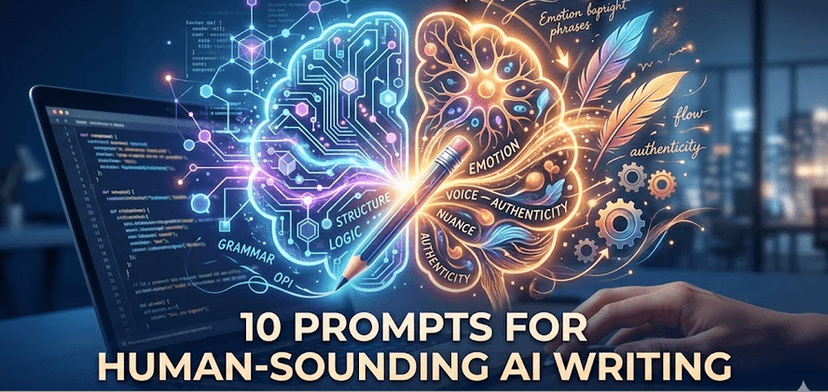
10 Prompts for Human-Sounding AI Writing (And How to Automate It)
AI writing often feels stiff and soul-less. Discover 10 powerful prompts to inject personality into your drafts and see how GenZWrite makes it even easier to bypass detectors.

GenZWrite
GenZWrite official

AI vs. Human Writing Quality: What Students Need to Know
Students rely on AI more than ever. Here’s how AI writing compares to human writing — and what schools actually care about.
GenZWrite
GenZWrite official

Why AI Writing Gets Flagged Even When It’s Human and How to Fix It
AI detectors often flag human writing due to patterns, not truth. This guide shows essay writers how to fix structure, improve flow, and use AI humanizers effectively.
GenZWrite
GenZWrite official
Humanize & Detect AI
Transform robotic AI text into natural, engaging content that passes detection and ranks higher.